On Air Now
Gold Radio Through the Night 12am - 4am
15 September 2026, 14:08 | Updated: 16 September 2026, 11:19


The Coronation Street video grabbed attention but it's the song that's endured.
The end of their first decade in pop was a time of change for Queen.
At the start of the 1980s they released The Game, their first album to feature a synthesiser. They followed that with their first soundtrack (Flash Gordon) and first Greatest Hits before getting more electronic with the disco-tinged Hot Space in 1982.
"Let's give them the works!" said Roger Taylor ahead of the recording of The Works, as Queen brought their whole career up to that point together.
The resulting album melded their classic rock sound, their operatic excesses, poppy sensibilities and newfound electro leanings into a lean, mean monster of an album.
The Works underlined Queen's superiority and would set them up for the following year's Live Aid, where they would steal the show.
And its second single and standout was 'I Want To Break Free', a song that has escaped the supposed "controversy" over its video to be one of the band's greatest.

Not for the first time, we'll point out just how blessed Queen were when it came to in-house songwriters.
Freddie Mercury wrote oh-so many of their biggest and best hits. ('Bohemian Rhapsody'. 'We Are the Champions', 'Don't Stop Me Now').
Brian May had plenty, too ('We Will Rock You', 'Fat Bottomed Girls', 'The Show Must Go On'). Drummer Roger Taylor also ('Radio Ga Ga', 'A Kind of Magic' 'Heaven For Everyone').

And then there was John Deacon. Arguably the quietest member of the band, the bassist left the group and retired from showbiz for good in 1997.
While he wasn't one to shout as loud as the rest, Deacon also pitched in with songs as good and as big as 'You're My Best Friend' and 'Another One Bites the Dust'.
And it was John Deacon who wrote 'I Want to Break Free': Music and lyrics.
Queen - I Want to Break Free (Official Lyric Video)
Thanks to its video (more on that later), and the widespread knowledge at the time about Freddie Mercury's sexuality (though he would never come out as gay or bisexual during his lifetime), there's a common belief that 'I Want To Break Free' is a song of gay liberation.
That wasn't the case at all.
Asked in 1985 (in an interview heard on the Greatest Video Hits II DVD) if the song was "dedicated for the gay world", Freddie replied: "No, not at all, not at all.
"To start off with that song was written by John Deacon, and he's a very happily married man, with about four children.

John Deacon talks about Queen's video of 'I Want To Break Free'
"I don't think where you got that message from. It's got nothing to do with the gay people at all.
"It's basically about everybody, it's just somebody who has a very tough life, and he just wants to break free from whatever problems he's got.
"It's got nothing to do with the gay thing. Besides, it's not my song anyway, John wrote itl"
As for what John wrote it about, it's widely reported that it's a women's liberation song (albeit written by a man), but when asked directly about it during a 50 Questions to John feature by the Official International Queen Fan Club in 1996, John answered in one word.

I Want To Break Free (Live At Wembley Stadium / July 1986)
"FRUSTRATION"
That fits with the lyrics, when you look at them divorced from the singer's personal life or the fun-and-frivolous video (don't worry, we'll get there!).
It sounds a bit like a break-up song at first ("I want to break free from your lies"), or a make-up song ("I've fallen in love for the first time"), a song of jealousy perhaps ("But I have to be sure when I walk out that door") but resolving in a cry for physical or likely emotional independence ("God knows, got to make it on my own").

Fred Mandel: Touring & Session Musician for Queen, Alice Cooper, & More! - Produce Like A Pro
All members of Queen were incredibly accomplished musicians. They could all tinkle the ivories.
On their previous albums, Freddie, Brian, John and Roger all have credits on Queen albums for piano, electric piano or synthesiser.
But they didn't mind getting a helping hand where necessary, with producers/players Reinhold Mack and Fred Mandel pitching in on occasion over the years.
And on 'I Want To Break Free' it's Fred Mandel keeping things fresh with the synths.
Otherwise it's Freddie on vocals, Brian on guitar, Roger on (electronic) drums, and John on bass, plus extra guitars.
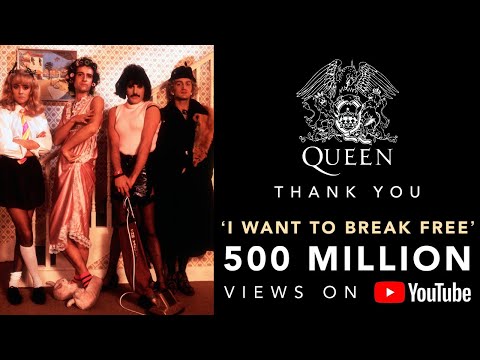
Queen - I Want To Break Free (Official Video)
Okay, we've got here at last.
Directed by pop video genius David Mallet, the video for 'I Want To Break Free' is a total riot, and comes in two very different parts.
The first 75 seconds is much in the British tradition of pantomime, cross-dressing and drag. It stars Queen as characters from Coronation Street.
Still running today, by 1984 the soap was already a part of the British establishment, having been running for the best part of a quarter of a century by this point.
'I Want To Break Free' starred Freddie Mercury as Bet Lynch (albeit with a black wig rather than a blonde one), Brian May as Hilda Ogden, John Deacon as Ena Sharples and, frankly, stealing the whole segment, Roger Taylor as Suzie Birchall.

Coronation Street - Bet's Attempts at Getting Cosy Get Interrupted by Steve
"Even though it was my song, I was devoid of any idea what to do for a video," John later said.
"And I think that was Roger's idea dressing up really, because 'I Want to Break Free' – I mean, obviously took everybody by surprise.
"We were a bit nervous actually because strangely enough, I mean, we all quite enjoyed it.
"Because it gave you the opportunity... when you've got an outfit on, you can actually act the character and it's not you, you're not being yourself. As silly as you like."
Roger Taylor revealed it was actually his then-girlfriend Dominique's idea, and agreed that they all embraced the silliness of it all.

Queen - I Want To Break Free (Making Of & Alternative Takes) (High Quality)
"We had done some really serious, epic videos in the past, and we just thought we'd have some fun," Roger said.
"We wanted people to know that we didn't take ourselves too seriously, that we could still laugh at ourselves. I think we proved that."
He later added on the 2011 Video Killed The Radio Star documentary: "I thought what character to make Fred? And I thought Liverpudlian slag is the answer."
Just before the halfway point of the video. Freddie-as-Bet-Lynch opens a door and the video shifts suddenly to a play on Vaslav Nijinsky in the Debussy ballet L'après-midi d'un faune, featuring the Royal Ballet choreographed by Wayne Eagling.
It then flicks back to our soapy domestic scene, and then a rip-fade back to the ballet to finish up.

Nijinsky 1912-L'Après-midi d'un Faune (full version)
Eagling apparently got into a bit of trouble for going ahead with this without checking it with his superiors, but it was the Corrie segments, that proved to be the most controversial.
Not in the UK, where the soap regularly racked up over 20 million viewers an episode and everyone knew the characters being played.
What's more, over here we had a rich tradition of pantomime dames and comic drag, and the video was very much taken in the giddy spirit it was intended.
In the US though, no-one had heard of Hilda Ogden, and – despite the success of everything from Some Like It Hot in 1959 to Tootsie in 1982 – cross-dressing was still seen as frankly deviant by much of the mainstream culture.
"MTV were very narrow-minded," complained Roger Taylor in an interview that later resurfaced on the band's YouTube series. "It was Whitesnake, f**king Whitesnake, and then another Whitesnake track.

Queen: On Video (Episode 25)
"And they decided they didn't think that men in drag was 'rock' enough, I guess. So they didn't play the video."
And Brian May later complained that the "ban" did some serious damage to the band's popularity in the US.
"I remember being on the promo tour in the Midwest of America and people's faces turning ashen," the guitarist told NPR's Fresh Air in 2010.
"And they would say, no, we can't play this. We can't possibly play this. You know, it looks homosexual.
"I know that it really damaged our sort of whole relationship with certainly radio in this country and probably the public as well."
He added: "That's probably one of the reasons why this sort of hole developed between us and the States, which was really a tragedy because so many of our hits would have fitted very well into the life of the States.
"But we didn't really get back in there until 'The Show Must Go On' and 'These Are the Days of Our Lives.' And even those weren't the hits that they were around the rest of the world."

The first place you could buy 'I Want To Break Free' was on The Works album, which was released on February 20 1984, having been trailed by the lead 'Radio Ga Ga' single a month earlier.
'I Want To Break Free' was released as a single on April 2, 1984 with The Works album track 'Machines (or 'Back to Humans')' on the B-side.
It soared all the way to number three in the UK singles charts - only Lionel Richie's 'Hello' and Phil Collins' 'Against All Odds (Take A Look At Me Now)' kept it off the top. It also went double platinum here with over 1,200,000 copies sold.
In the US, maybe thanks to that "controversial" video, it didn't do so well, stalling at number 45 on the Hot 100. But quality will out, and the song did eventually go platinum Stateside, with over a million sold.

Frank Turner - I Want To Break Free (Queen cover)
If you set aside all the post-Freddie Queen live performances of 'I Want To Break Free' (Lisa Stansfield, Paul Rodgers, Adam Lambert), the solo Queen turns (Roger Taylor), and all those tribute acts (Queen Forever, Mercury, Marc Martel) there's been a few covers of 'I Want To Break Free', usually in the live arena
The big picks include The Royal Philharmonic Orchestra, Boyzone and Westlife (both as part of a Queen medleys) and Frank Turner.